
Environmental intelligence
for natural capital asset management
We use freshwater as a diagnostic indicator of ecosystem health, providing land managers and stewards with the continuous data and insights required to measure, verify, and optimise the ecosystem services and operational outcomes of nature-based investments across projects, landscapes, and entire river catchments.
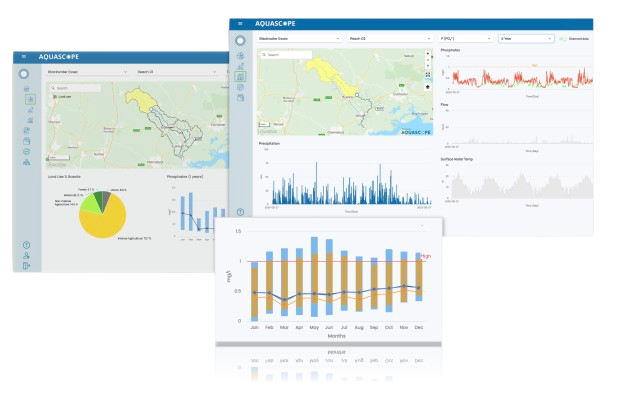
Aquascope gives you the confidence to act and the evidence to invest.
Partners and Alliances

Water stress is a global problem, but central to guiding solutions
Water availability, condition, and effective management underpin human health, food production, climate resilience, and biodiversity. Yet freshwater systems worldwide are deteriorating faster than forests or oceans. As these systems are deeply interconnected, their decline is creating a silent crisis for businesses, communities, and ecosystems.
Understanding freshwater condition is therefore essential to guide ecosystem restoration, reduce risks to human health, strengthen business resilience, and enable the growth of nature-based economies.
Quantify the impact of your projects on downstream freshwater ecosystems
WATER
Hydrological Condition
Flow, water temperature, dissolved oxygen, biochemical oxygen demand, nitrogen, phosphorus, and sediment levels provide key indicators of freshwater condition, hydrological stability, and overall ecosystem integrity across catchments.
Supports:
- Planning for water supply availability and distribution
- Understanding of supply chain risks
- Project Impact reporting
CARBON
Biogeochemical Flux
Dissolved organic carbon and nitrogen dynamics in water enable the quantification of carbon storage, transport, and landscape-scale carbon fluxes across interconnected terrestrial and aquatic ecosystems from source to sea.
Supports:
- Supporting certification for carbon projects
- Operational planning water abstraction and transfers
BIODIVERSITY
Ecological Response
Nutrient levels, pathogens, and phytoplankton communities act as sensitive bio-indicators of ecosystem stress, ecological balance, and risks to biodiversity and human health.
Supports:
- Impact measurement on nature and biodiversity
- Project Impact reporting
From impact measurement to continuous monitoring
BASELINE
Landscape modelling
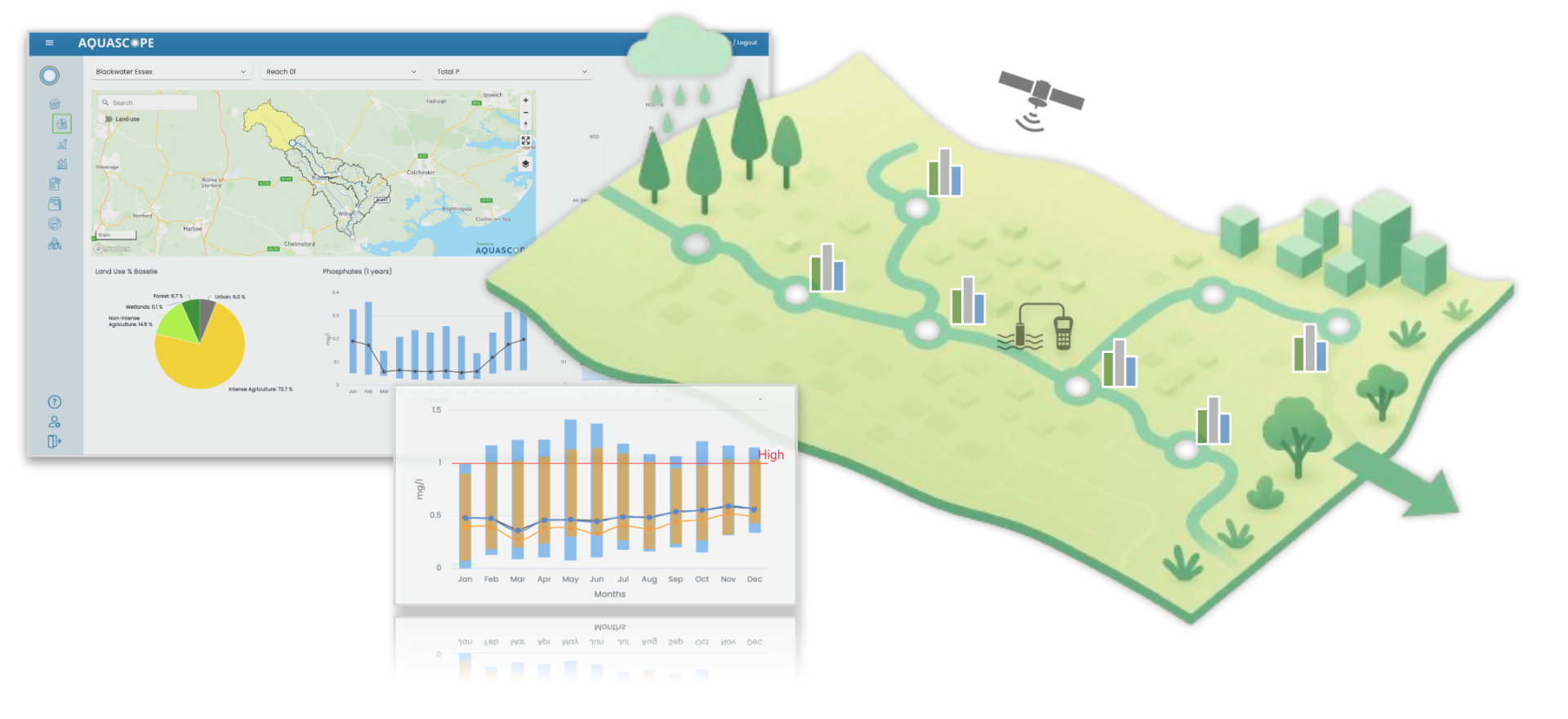
Landscape modelling provides current and historical conditions across entire river catchments and project areas, helping you understand where to start when assessing and valuing natural capital assets.
Link to case studySCENARIO
Future change scenario planning
Run future land use and point source emission scenarios to set impact measurement goals that support compliance targets, support certification pathways, and inform coordinated upstream to downstream operational planning.
Link to case studyMONITOR
Continuous monitoring
Our sensor-agnostic platform delivers continuous, catchment-scale ecosystem monitoring, placing projects in their full environmental context. Proprietary models are continuously updated with daily weather data, while targeted sampling and calibration enhance accuracy, enabling on-demand reporting and confident, evidence-based decisions.
Link to case studyFORECAST
Daily water quality and flow forecasting.
Aquascope provides daily forecasts of water quality and flow conditions, helping users understand current system dynamics and plan interventions with confidence. Forecast outputs can be configured for single locations or integrated across multiple reaches to support coordinated operational planning at catchment scale.
Link to case studyWho benefits from our data and insights
Financial Institutions
Asset managers and investors use our data to quantify nature-related financial risk, evaluate water-positive outcomes, verify project performance, and support increased returns from natural capital investments.
Value created:
- Lower cost impact reporting for projects and ecosystems
- Greater integrity and alignment to certifications
- Reduced project risk
Corporates
Corporates use our insights to move beyond water risk screening and understand the downstream impacts of site operations and supply chains. We enable water stewardship strategies to realise impact and resilience in local value chains.
Value created:
- Value quantification for water conservation projects
- Faster certification and insetting pathways
- Reduced site and supply chain risks (Scopes 1-3)
Utilities
Utilities use our data to monitor catchment condition, forecast water quality and availability risks, and guide restoration investment to protect upstream supplies and infrastructure resilience.
Value created:
- Link catchment planning to downstream supply risk management
- Use forecasting to reduce treatment costs through better decisions
- Quantify how catchment restoration improves water supply value
Public Sector and Civil Society
Catchment managers, NGOs, community groups all use our insights to support water stewardship, policy development, and coordinated landscape-scale environmental action.
Value created:
- Better water policy and catchment planning
- Forecasting reduces health and safety risks
- Support public engagement and enable citizen scientists
Three steps to better water management
Our streamlined process makes water monitoring and reporting accessible and actionable for all
Model and Measure
Access modelled catchments on our platform and integrate sensor or sampled data
Data Analysis / API
Access comprehensive live and historical data on water quality and flow via API.
Insights and Reports
Access insights, run scenarios, set up alerts and activate our complete monitoring and reporting services.


Go with the flow...
Join us to put water at the heart of better decisions for nature and society